
Why our students depend on us (and how we can change that)

How often do your students look to you before doing… anything?
Whether it’s checking an answer, asking about what to do next or waiting for confirmation before speaking, many learners rely heavily on their teacher throughout their lessons. "But that's a good thing", I hear you say. And you're right, this isn’t necessarily a problem in itself. After all, our role as teachers is to guide and support our students. But it does make me wonder how much responsibility our learners are really taking, and how much more they could gain.
This raises a key question: how can we help students rely less on us and more on themselves? This is where learner autonomy comes in. Over 10 years ago, I published my Master's research thesis investigating EFL teachers' and students' perceptions of learner autonomy in Spain (available here). It's a topic that continues to shape not only my classroom practice, but also my work in teacher coaching and development as an Academic Manager.

So, what do we mean by learner autonomy?
It’s a term that gets used a lot in ELT, often alongside ideas like independent learning or self-study. At its core, it simply refers to learners taking a more active role in their own learning - in making decisions, reflecting on their progress and engaging with the language beyond the classroom.
My research
When I explored this topic in Spain, I wanted to understand how both teachers and students viewed learner autonomy. Were they enthusiastic about it? Did they feel it was possible to incorporate into ELT in practice? And how did they interpret their roles in developing independence?
Teachers and students generally shared positive views of autonomy. Most agreed it was desirable for learners to take more responsibility for their learning. However, some gaps also emerged. Students were more enthusiastic about making decisions in the classroom than about developing independent learner habits. Teachers, on the other hand, valued autonomy but recognised practical constraints that could limit its development - things like time pressure, exam-focused curricula and student expectations for teacher-led lessons.
In short, while autonomy is desirable, putting it into practice can be a little more complex.
Why autonomy matters
So why does learner autonomy actually matter in the classroom? When learners take responsibility for their own progress, they tend to be more motivated and engaged. They also become better at adapting learning strategies to suit their individual needs. Autonomy helps learners process language more deeply, remember it for longer and develop lifelong learning habits – skills that all go far beyond the English language classroom (see the references below for more insight if you don't want to take my word for it!).
In other words, autonomous learners aren’t just completing tasks - they're learning how to learn. They gain confidence in their decisions and develop the skills to continue improving even when a teacher isn’t present.

Practical ways to encourage autonomy
In my experience, developing learner autonomy isn’t about big, dramatic changes. It’s the small, consistent moments in every lesson: a well-timed question, the opportunity to make a choice, a prompt to help reflection... It's these small adjustments that can slowly help learners take ownership of their learning.
1. Start small: autonomy grows gradually
Autonomy doesn’t develop overnight. You don’t need to transform your learners into fully independent students in one day. Instead, look for small opportunities to give them a little more responsibility - even small changes can make an impact.

For young learners, you might assign classroom helpers or assistant roles. Students can take on simple jobs such as:
handing out materials
checking the register
leading class tidy up
These small responsibilities give learners a sense of ownership over their classes and can be gradually expanded as they become more confident.
2. Ask more, talk less: create thinking space
As teachers, it's natural to want to step in with the 'right answer', but sometimes the most helpful thing we can do is pause, prompt, and let our students work it out for themselves.
Instead of immediately correcting a mistake, try prompting students to think:
“Where could you check that?”
“Does that sound right to you?”
“Can you think of another way to say it?”
This shift gives learners the chance to notice, reflect and solve the problem on their own. During pair work, let students discuss and attempt the answers before you intervene. Not only does this build confidence, but it also helps them develop skills to figure things out independently for future lessons.
3. Build reflection into lessons
Reflection helps learners become aware of their own progress and challenges. Simple strategies could include:
a quick end-of-class survey: “What did you find easy or difficult today?”
keeping a small learning journal where students track new vocabulary or expressions (I'm also a fan of "My favourite mistakes" list - students note down the mistakes they regularly make, in an attempt to prevent them becoming too fossilised)
asking learners to set one small goal for the next lesson
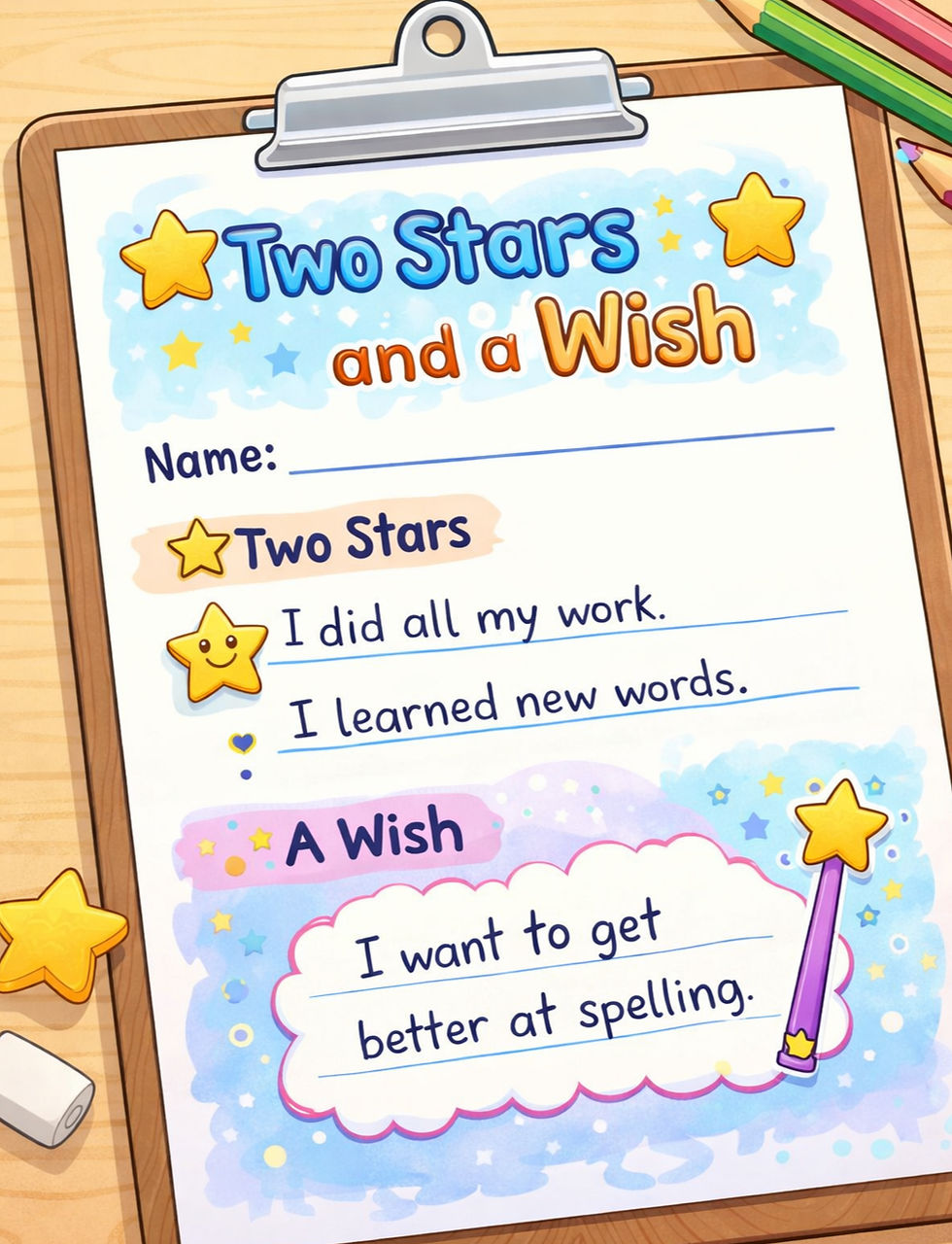
With younger learners, reflection can be playful: use colour-coded stickers, thumbs-up/thumbs-down, or 'draw-a-smiley-face' to let them indicate how confident they felt with the lesson. Take this one step further when finishing a unit of work or term and encourage little ones to complete a 'two stars and a wish' type self-assessment. These exercises help learners to notice their own learning, an essential step towards independence.
4. Provide choice
This is one area where many teachers feel a little uneasy. Giving learners a bit of 'power' in the classroom can make us feel like we’re letting go, but the truth is that offering choice is a simple way to boost motivation and engagement. For example:
let students choose between tasks or activities during a lesson
students select the topics for a discussion, a writing task or project work
students decide which tasks they will complete as homework
You can even offer structured choices: “Do you want to practice these words in a game, a speaking activity or a reading exercise?”. The other options might well become homework tasks, so no one misses anything essential, and interestingly, my students often choose what I’d consider the more challenging option when given the choice. Allowing learners to have a say fosters engagement while still keeping the lesson on track.
5. Explicitly teach learning strategies

Many learners don’t automatically know how to study or approach tasks in the best way - what some call 'learning how to learn'. With my teen students, this is particularly true when it comes to writing: most haven’t been taught how to plan or structure a piece of writing in their high schools, so they don’t automatically know where to start. Simply telling students: "Don't forget to plan!" isn't enough.
We need to explicitly teach learning strategies to our students so that they'll have the skills and tools to apply independently. Examples include:
how to learn and review vocabulary effectively - using flashcards, mind maps, the concept of spaced repetition
how to approach writing tasks - breaking a task into steps, planning ideas, checking we're on task before writing
how to make the most of listening exercises - listening for keywords, repeating sentences, noting new vocabulary
These 'strategy moments' in class help learners develop skills they can transfer outside the classroom, gradually building independence and confidence in managing their own learning.

6. Promote learning outside the classroom
For many students, this is the most difficult. But as teachers, we know that language learning doesn’t stop when the lesson ends. Encourage students to:
watch series, films, or videos in English - even for just 5–10 minutes a day
listen to podcasts, songs or audiobooks in English
use apps or social media in English
practise speaking with classmates, friends, family
for younger learners, you could create an 'English treasure hunt' to spot English words around the house/their neighbourhood and report back to the class
Small, regular exposure can have a big impact over time.
My reflections
Developing learner autonomy is much like establishing routines in the classroom: its success depends on consistency, patience and gradual implementation.
It’s not about a single lesson or activity, it’s about creating an environment in which learners are encouraged to take small steps towards responsibility. This can feel unfamiliar for both teachers and students at first, but over time I truly believe it leads to more engaged, confident and capable learners.
For me, learner autonomy isn’t just a classroom concept, it’s a principle that continues to shape both my teaching practice and my work in teacher development. When we create opportunities for students to take responsibility, make decisions and reflect on their own learning, we’re helping them develop skills and habits that last a lifetime.

What’s one small change you could make this week to give your learners more responsibility?
Further reading:
Benson, P. (2011). Teaching and Researching Autonomy. London: Routledge.
Boud, D. (1988). Developing Student Autonomy in Learning. London: Kogan Page Ltd.
Cambridge University Press ELT (2019). Encouraging Learner Autonomy - Samantha Lewis. Youtube video, available at: https://youtu.be/uN-90zM4KmM?si=zhLlCOKV948PNtUe (Accessed: 31 March 2026).
Cambridge University Press ELT (2021). What research tells us about improving learner autonomy with Ben Knight. Youtube video, available at: https://youtu.be/TtGOeoYnv4M?si=gXAehYUdLOIqdyci (Accessed: 31 March 2026).
Harmer, J. (2007). The Practice of English Language Teaching. Harlow: Pearson, pp. 394-409.
Holec, H. (1981). Autonomy and foreign language learning. Oxford: Pergamon.
Littlewood, W. (1999). Defining and developing autonomy in East Asian contexts. Applied Linguistics. 20(1), pp. 71-94.
Oxford, R. (2008). Hero With a Thousand Faces: Learner Autonomy, Learning Strategies and Learning Tactics in Independent Language Learning. In S. Hurd & T. Lewis (Eds.), Language Learning Strategies in Independent Settings. Bristol: Multilingual Matters, pp. 25-41.


Comments